by Mike Ege
Editor in chief, The Voice of San Francisco
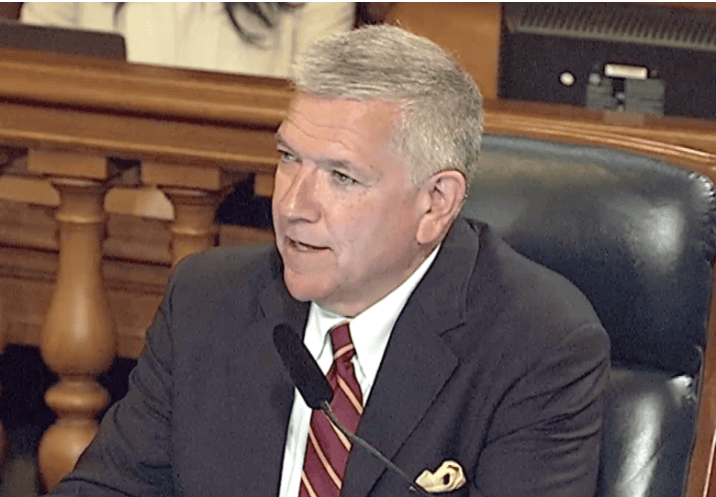
District 6 Supervisor Matt Dorsey speaking during a Public Safety and Neighborhood Services Committee hearing on Southern Police District funding, on May 28, 2026. SFGovTV
Is there really a “Nonprofit Industrial Complex?”
District 6 Supervisor Matt Dorsey is uncomfortable with the term. “But I’ve also been frustrated to go to the budget committee and see so many employees of nonprofits spending their day there lobbying for more money,” he told The Voice in a recent interview. Which is why Dorsey says it’s time to level the playing field by requiring more transparency from city-funded nonprofits that lobby.
He went on to describe a budget committee meeting back in May where employees of the San Francisco Pretrial Diversion Project testified one after another in favor of the Sheriff’s Department continuing to contract with the agency despite enough doubts about their services that the San Francisco Superior Court proposed that they be handled in-house by the city’s Adult Probation Department instead.
“I asked my intern, ‘Could you count who’s doing the public comment on this item,” Dorsey related. “It turned out that 18 out of 30 who testified were employees or board members of the Pretrial Diversion Project.”
San Francisco’s Campaign and Governmental Conduct Code requires most individuals and groups seeking to influence legislation and policy to register with the Ethics Commission and file regular activity reports. Nonprofits are famously exempt from the rules. The SOMA supervisor wants to introduce legislation that would remove that exception.
City Hall watchers are familiar with the infamous “addback day” during the budget process, which routinely features hours of public comment dominated by nonprofit groups and their allies. The point is simple: lobbying by nonprofit service providers has made them influential players in shaping San Francisco’s social policy, especially when they are seeking to maintain the city contracts they depend upon for their existence.
Prior to the mid-20th century, most welfare services in the United States were provided by churches, settlement houses, mutual aid societies, and charitable organizations. Governments primarily funded public schools, infrastructure, and the police, and provided limited poor relief. That changed by necessity with the Great Depression; the response was the New Deal, which dramatically expanded the federal government’s role through Social Security, unemployment insurance, and other programs.
Subsequent administrations of different ideological persuasions, from the Great Society to Reaganomics to Welfare Reform, alternatively increased or decreased the scope of government services, and increased reliance on community groups to provide them. Public benefit groups became contractors, and governments found the new model convenient because it provides greater flexibility, savings from lower labor costs and philanthropic partnerships, and, ideally, better service due to local expertise and lived experience. It’s become a defining feature of the modern U.S. social safety net.
San Francisco is no exception, and the percentage of the city services budget pie that goes to nonprofits has ballooned in recent years, in part thanks to ballot measures approved by voters in 2018 that created special taxes meant to raise funds for homelessness and child care programs, which also set a precedent for lowering the voter approval threshold for enacting such taxes.
But with the contracting process comes political fights over budgetary table scraps. The larger point is that attempts to reform social policies that don’t work often run into “limited good” arguments from contractors who depend on government contracts for their lifeblood but pose as altruistic political actors in the legislative process. It’s something you see play out over and over again in policy domains ranging from homelessness and drug rehab services to restorative justice.
“I have been surprised at the degree to which some nonprofit partners are real combatants on public policy,” Dorsey told us. “In the discussion over drug-free supportive housing, in the recovery-first ordinance, some city-funded nonprofit partners decided to weigh in, like they’re not even engaging in a good-faith kind of policy-making effort, to delegitimize and misrepresent what the policy is about. It was much more like negative campaigning than serious policy engagement.”
Ostensibly altruistic community groups act increasingly like industry lobbyists, and their interactions with elected officials look increasingly like clientelism — most recently when District 10 Supervisor Shamann Walton was fined by the Ethics Commission for accepting a custom portrait of himself from one nonprofit organization, and reimbursement for travel costs from another. The pattern reinforces the case for greater transparency.
“When I see permanent supportive housing providers and their employees showing up at public comment, it’s not lost on me that, literally, anything they would be doing at the buildings they manage — sweeping the sidewalk, doing an ambassador patrol- would be a better use of time than sitting in budget committee.”
Dorsey has sent a drafting request to City Attorney David Chiu for legislation to eliminate the lobbying loophole for nonprofits, in which he describes the current situation as a “troubling combination of factors” that “argues for greater transparency.”
“If there was a time when such a broad exception for nonprofit lobbying once made sense, it makes no sense now,” he writes. “Closing this loophole on nonprofit lobbying — like lobbying regulations more generally — is more essential than ever to restore public confidence in the investments we make in nonprofit partners, and to assure the responsiveness and representative nature of San Franciscoʼs government and institutions.”
Needless to say, nonprofit leaders aren’t very hot on the idea. Asked by the Chronicle what he thought, Tenderloin Housing Clinic director Randy Shaw balked, saying that nonprofit lobbying “wasn’t on the list of top 10,000 problems” in the city.
Well, it’s certainly on the list now.
“Let’s see where the political support and opposition are going to be. Then people can weigh in as we’re working on this,” Dorsey told us. “If we can introduce it in September, I don’t see any reason that we couldn’t have this enacted by the end of the year.”
Check out links to our latest content below, or just bookmark our homepage to see the latest.