

Chapter 8
Boosterism, Brokerage and Uneasy Bedfellows:
Networked Urban Governance and the Emergence of
Post-Political Orthodoxy
Iain Deas and Nicola Headlam
Pre-publication final draft chapter in: Paddison, R. and Hutton, T (eds) Cities and
Economic Change: Restructuring and Dislocation in the Global Metropolis, London:
Sage.
Background
This chapter explores recent experiences of city governance, focusing in particular on the
emergence of entrepreneurial governance strategies and considering whether this represents a
new orthodoxy in urban policy. Drawing upon its application in different contexts, the
chapter attempts to identify the different elements of entrepreneurialism in urban governance,
arguing that the evolution of governance in cities is more complex and multi-faceted than is
sometimes appreciated. The chapter concludes by considering the degree to which urban
governance can be considered ‘post-political’ and speculating on the scope for a future
deepening in the extent of neoliberal governance strategies.
City policy elites in different international settings have over several decades tried to
develop governance structures and policy initiatives that place the pursuit of economic
growth as their principal objective. This has applied to established cities grappling with the
collapse of their manufacturing bases and the resultant social and environmental
consequences, where the challenge is to develop new economic potentials and possibilities
that might eventually form part of a future raison d’être. It has also applied to apparently
more successful cities, where the retention of competitive advantage becomes ever more of a
challenge in an international context in which capital and labour are perceived to be highly
mobile, and in which economic performance is measured relative to rival cities.
Yet identifying effective ways in which to govern these different types of city is far from
straightforward. Policy-makers have long sought effective mechanisms through which to
govern urban areas in ways that reconcile social and environmental objectives with economic
development goals, while simultaneously representing citizen interests in the decision
making process. More recently, added to this historic purpose of urban government has been
a different set of challenges. One has been the daunting task of managing the loose and
sometimes disparate network of agencies and actors involved in different ways in devising
and delivering urban policies. This is reflected in a relentless search for appropriate
institutional vehicles through which to govern the reticulated terrain of the city. Bolstering
institutional capacity and developing ‘thick’ governance structures have become important
elements of a policy doctrine which suggests that stable, cohesive political relations can help
to advance urban economic growth. Alongside these structural challenges, another goal
relates to the practice of governance. Some proponents of the modernization of urban
governance have posited that behavioural norms amongst urban policy-makers need to be
radically reoriented, instilling amongst elite actors a more entrepreneurial, business-friendly
mindset that contrasts with the kinds of bureaucratic culture held to have hampered urban
economic growth in the past.
These kinds of principle have helped induce a sometimes radical transformation in the
ways in which cities are governed. From the late twentieth century, there has been
widespread recognition that public policy formulation and delivery is no longer the exclusive
preserve of local government, but is instead developed and implemented through an array of
institutions and processes, both formal and informal, which form governance networks that
sometimes look quite different to municipal governments of the past (Pierre and Peters,
2000). Previously, responsibility for inducing urban economic and social revival rested
largely with the state, through a sometimes uneasy combination of central and local
government. More recently, however, the delivery of urban policy has undergone significant
change, as the governance of cities has fragmented across a complex assortment of unelected
non-departmental public bodies, in harness with a variety of private and voluntary sector
actors.
This shift from government to governance has been extensively documented, in part
because of the complexity and disparateness of the institutional structures and policy
initiatives that have emerged. The emergence of multi-actor, cross-sectoral coalitions and
partnerships, the growing significance of elite actor networks as a discrete and specific
modality for urban governance, and the emergence of hybrid forms of governance have
disrupted the binary relationships between state and market which once underpinned social,
economic and political relations in cities. International experience is one in which monolithic
local government has been in decline, with power and responsibility dispersed across
networks of institutional actors. In part, this has been driven by a consensus around the notion
that economic development in cities and regions is best pursued on a multi-sector
‘partnership’ basis. This view holds that it is through cross-sector, inclusive partnership
working that policy coherence can best be maximized and resources most effectively
marshalled in the context of otherwise highly fragmented institutional environments.
Building capacity across networks and encouraging stable political relations, often linked to
consensual ideas about what is appropriate in policy terms, is thus often viewed as a key
ingredient of successful urban economic development.
The result is that alongside the fundamental shift in urban governance structures and
policy actor views, there has also been an equally far-reaching transformation in the
substantive content of urban policy efforts. In particular, there is wide-ranging evidence that
urban policies have begun to move beyond their historical focus on ‘problem’ urban areas
and towards a concern with promoting economic growth regardless of urban socio-economic
context. Two factors have helped prompt this shift. The first is the emergence of the view that
the economic vitality of cities is a critical component of broader national economic
competitiveness, and that concerted effort is therefore needed to help maintain and enhance
the performance of already successful places (for example, by accommodating growth
pressures and facilitating further development), as well as to manage, slow or reverse the
decline in ‘lagging’ areas. A second factor underlying the reorientation of urban policy relates
to hegemonic discourses of global urban economic competition and urban entrepreneurialism,
and the contested view that the way in which cities, regions and other sub-national territories
are governed has become more important in the context of an internationally more integrated
economy over which nation-states have limited and diminishing influence (see, for example,
Brenner, 1999; Jessop, 2000; Scott, 2001b). This in turn has helped fuel a growing sensitivity
amongst urban policy to the performance of their cities when benchmarked against
international peers, and a related desire to bolster their standing by focusing policy more
exclusively on the promotion of economic growth.
In the remainder of this chapter, we explore in more detail the politics associated with this
networked, entrepreneurial governance of cities. The chapter reviews a variety of attempts to
interpret the emergence of urban governance arrangements characterized by a series of
complex, often nebulous urban networks of elite actors which can transcend formal
institutions and around which policy for economic development, inward investment activity,
and the branding, marketing and promotional activities of cities can cohere. Firstly, we look
briefly at shifts in the substance of urban economic development policies, arguing that
boosterist strategies, once viewed as novel, are now central to economic development
strategies. Secondly, we highlight some of the research efforts to describe and decode the
changing structures of governance, noting in particular the characteristics of the shift from
first to second generation governance. And third, we devote the bulk of the chapter to a
review of concepts, exploring critical efforts to interpret shifts in urban governance, and
arguing that while there is evidence of the emergence of a post-political orthodoxy, its
contours are more complex than is sometimes appreciated.
Boosterism as the New Imperative for Municipal Leadership?
Boosterism has become central to the policy-making agenda for cities. Alongside efforts,
inter alia, to create flexible local labour markets, stimulate property-led commercial and
residential redevelopment, enhance business competitiveness through light-touch regulation,
subsidy and non-punitive and non-redistributive taxation, and maintain a physical
environment conducive to internal and external business investment, boosterist strategies are
at the core of urban economic development policy in many cities (Brenner and Theodore,
2002). They infuse a number of related attempts employed by cities to promote economic
growth. Attempts to attract foreign direct investment, for example, have often worked in
tandem with place promotion. Similarly, knowledge-based economic development – a
prominent element of the strategy employed by many cities – is seen as critically dependant
on a city’s ability to promote itself to skilled workers, lured by the promise of ‘liveable’
neighbourhoods in which affordable housing is situated in secure, well-designed residential
areas with good access to employment opportunities and a range of public and private
services. In some cases, place promotion has also emphasized the existence of a vibrant
cultural life, a social climate of tolerance and liberalism and a sense of enterprizing creativity
amongst its residents as further ingredients in the mix of attractions that help entice skilled,
‘creative’ professionals, drawing upon what is held by some to be the exemplary experience
of places like Austin, Texas. Ideas such as this, propounded by policy entrepreneurs like
Richard Florida (2002), have proved extremely alluring to urban policy actors. This is despite
claims that a focus on liveability and creativity in stimulating economic development can
lead to profoundly unjust socio-economic outcomes (Peck, 2005; McCann, 2007), especially
when applied inappropriately in the context of low-growth or no-growth industrial cities in a
range of different international settings (see, for example, Zimmerman (2008) on Milwaukee,
or Sasaki (2010) on Osaka). Under this critique, the fixation with boosterism is said to have
concealed the regressive consequences of urban policies which no longer seek to resolve
intractable social problems in cities (Paddison, 2009).
The emphasis on boosterist forms of urban economic development relates in part to a
world-view amongst policy elites which views cities as competing at a global scale: for
events, mobile labour and capital, publicity and so on. A feature of the rise of neoliberal
governance of urban economies is the receptiveness of local policy actors to discourses of
international urban competition. This particular form of entrepreneurial behaviour amongst
urban policy actors has been acknowledged for many years (see, for example, Harvey,
1989a). Yet as Lovering (2001) has argued, it is based on a perception that in important
respects is divorced from an empirical reality in which many cities, at least those outwith the
major global cities, are weakly integrated with the international economy. This has prompted
critics like Lovering to argue that policy-makers are unrealistically preoccupied with
consolidating or improving cities’ international standing, at the expense of the more mundane
but under-appreciated issues, for example, of building skills amongst the labour force,
ensuring an adequate supply of developable land, providing efficient infrastructure, or
maintaining and enhancing readily accessible and equitably allocated consumption services.
Alongside competition to attract and retain labour, entice business investment, or lure
tourists and prestige events, boosterist strategies employed by urban policy actors have also
been geared towards the procurement of public funding. Some cities, as a result, have
received regular injections of finance, capitalizing on the adroitness of their urban elites in
constructing what Cochrane et al. (1996: 1331) refer to as ‘grant coalitions’ that can pinpoint
opportunities for funding and articulate their case to external funders in central government
or supra-national bodies like the European Union. There are, however, losers in this process,
as some cities have proved less successful in attracting discretionary grant funding – even in
cases where there were ostensibly strong objective arguments for resourcing on the basis of
socio-economic circumstances (Southern, 2002; Davies, 2004). In some instances, this has
reflected concern from national or supra-national government about inter-institutional friction
at the local level, a history of overt local authority hostility to higher levels of government,
the supposed marginalization of the private sector or a continued weddedness to what have
been seen as outmoded and non-entrepreneurial distributional concerns (see, for example,
Boddy, 2003).
This form of ‘challenge funding’ has nevertheless remained a feature of urban policy. In
Britain, it has existed intermittently over several decades, from the City Challenge initiative
launched in 1992 to the Regional Growth Fund introduced in 2010 and the competition for
the award of Enterprise Zone status in 2011. But even during periods in which central
government opted to allocate regeneration resources on a more objective and non-competitive
basis (principally through the use of statistical indices of deprivation), the embeddedness of
the idea of inter-city competition amongst local policy actors remained apparent in the
continued interest in securing flagship cultural and sporting events. For example, the
competition amongst British cities to be awarded European Capital of Culture status for 2008
involved bids, inter alia, from Birmingham, Bristol and Newcastle, as well as Liverpool, the
eventual winner (O’Brien, 2011). That the competition attracted media interest on a scale
entirely disproportionate to the modest funding on offer to the successful city was partly
reflective of the degree to which this form of entrepreneurial urbanism had impregnated the
outlook and behaviour of policy actors. This, in turn, reflected the policy-maker consensus,
following the experience of several other cities, notably Glasgow in 1990 as European City of
Culture, which held that substantial spin-off benefits could be generated directly as a result of
the award of Capital of Culture status and the resultant growth in tourist and visitor numbers,
and indirectly as a result of the fillip to the winning city’s international status and visibility
(Mooney, 2004; Garcia, 2005).
Boosterism, place marketing and inter-city competition have evolved over several decades
to become accepted features of the urban policy landscape in many countries. This has
generated extensive academic interest. But while the development of these areas of activity
amongst city policy actors confirms that local economic strategies have been driven by an
underlying desire to become more entrepreneurial, other types of activity pursued by urban
institutions have changed in sometimes more subtle and complex ways. Even in the many
instances in which the local state has ceded its role as direct deliverer of services to private
and voluntary providers, it has often managed to continue to play an important, if indirect,
role as commissioner, planner or regulator (‘steering’ instead of ‘rowing’, in Osborne and
Gaebler’s (1993) widely employed metaphor). This reoriented role, in several European
countries, is now susceptible to further change. ‘Austerity’ measures introduced in the wake
of the international financial crises of 2007–08, in the form of radical programmes of public
expenditure cuts, potentially preface a further, more fundamental redistribution of power
away from the local state and towards a range of civil society actors and business interests
amongst whom an underlying market logic often underpins decision-making (Peck, 2012;
Meegan et al., 2014). The need for local actors in many countries to find new ways of
delivering services in the face of dwindling resources increases the possibility of further
diversification in the range of institutions operating alongside elected local government,
thereby rendering still more complex the often elaborate networks through which cities are
governed – as the next section of the chapter goes on to explore.
Brokerage, Networks and the Shift Towards Second Generation
Urban Governance
A unifying theme across cities in different contexts is that contemporary urban governance
has often evolved in ways that have left it more complex and less transparent than before.
Unsurprisingly, the complexity of urban governance arrangements has presented some
difficulty for the many attempts to conceptualize local institutional and policy networks,
resulting in a ‘cacophony of heterogeneous concepts, theories and research results’ (Oliver
and Ebers, 1998: 549). What is clear amidst this variability and complexity, however, is that
contemporary governance is characterized increasingly by its network character (Powell,
1991). In place of rigid, hierarchical government dominated by clear lines of accountability
and bureaucratic modes of decision-making, contemporary network-based urban governance
is held by proponents to offer a leaner and more flexible means of promoting economic
development and social well-being (Parker, 2007: 116). To adherents, the rigidity of old-style
hierarchical ‘big government’ ought ultimately to be supplanted by more inclusive and
elemental forms of partnership-based governance:
Hierarchy, generally, is losing its legitimacy while partnership is in the ascendant as
different interest groups flex their muscles and individuals start to take back control
of their lives from organizations and governments. (Handy, 2004: 98)
For many European cities, the embrace of looser network-based forms of governance has
therefore been accompanied by a rejection of formal hierarchical government (Parker, 2007).
This has involved a transition to forms of governance based on privatization, contracting and
marketization. The result has been an upsurge in the array of quangos, cross-sector
partnerships, sub-contracted service providers and voluntary sector bodies upon which the
local state has become ever more reliant for the delivery of public services (Goss, 2007).
Authors such as Kjaer (2009) have argued that this represents a fundamental transition to a
new, network-based form of governance, succeeding an earlier post-war settlement in the
form of the development of big government, and a second ‘new public management’ market
facing phase from the 1970s.
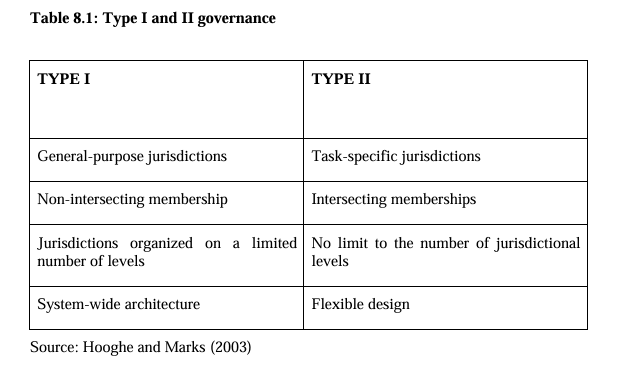
A different perspective is provided by Hooghe and Marks (2003), who distinguish
between formal and informal governance mechanisms as drivers of different types of multi
level governance (Table 8.1). Under this interpretation, Type I governance is based on
‘stacked’ or ‘nested’ institutions, in hierarchical form, whereas Type II institutions are
characterized by their flexibility, their connectivity within and between other jurisdictional
levels, and their ability to focus on specific policy issues. As a result, Type II institutions are
said by proponents to be more fleet-of-foot and flexible – but also less likely, sometimes by
design, to be lasting. They may also less likely to be democratically accountable or subject to
direct or indirect citizen scrutiny, in contrast to formal Type I institutions. The upsurge of
‘government by task force’, of concordats, agreements and of institutional and organizational
hybrids of varying shapes, sizes and complexity provides evidence of the rise of this type of
second generation governance.
The existence of second generation entities is part of the wider emergence of networked
forms of urban governance. This is evident in the UK, for example, where efforts in the
period 1997–2010 to develop coherent sub-national governance and economic development
policy remained restricted to Type II form, as attempts to develop more permanent and
democratically accountable institutions ultimately foundered because of the combination of
lukewarm support from central government, a wholesale lack of popular endorsement, and a
reticence amongst local policy elites to sanction the creation of more formal and powerful
institutions. That Type II entities are not susceptible to the vicissitudes of democratic scrutiny
may itself have been important in informing the unwillingness of these elites to move beyond
the complex but impermanent network of governing institutions in cities and their regions.
The evolution of urban governance, and its network form, rests in part upon an optimistic
stance which views it as best able to promote urban economic development. However, this is
not a view that has gone uncontested. The black box nature of many of the second generation
networked governance mechanisms has attracted the critical attention of many scholars.
Skelcher (2005), for example, argues that Type II governance entities break down into three
distinct sub-categories (club, agency and polity-forming), on the basis of their variable
legitimacy, and the form and extent of democratic consent and accountability (Table 8.2).
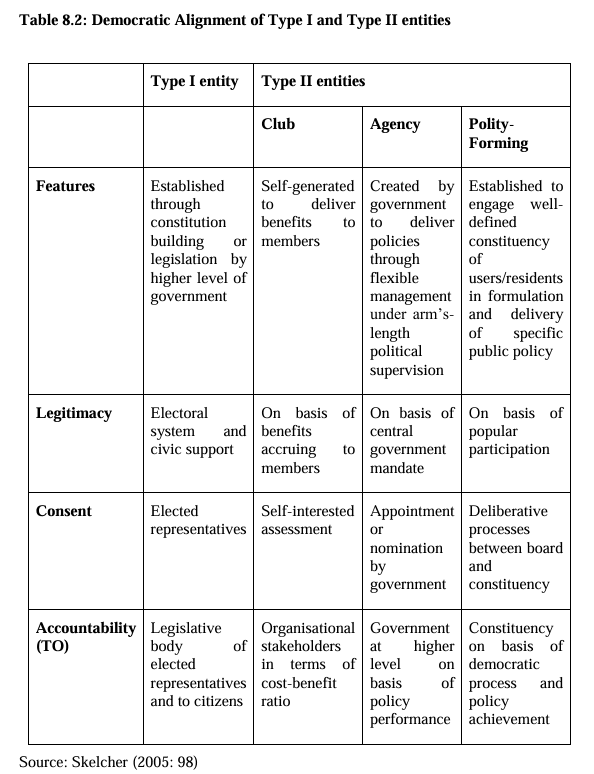
Clearly the three different types of Type II entity can vary in character. In focusing on
distributed public governance and the specific differences between Type I and II governance
mechanisms, Skelcher’s perspective is more critical than those propounded by advocates of
looser, network-based governance as a normative means of promoting economic growth. It is
to the critique of ‘governance enthusiasm’ that the chapter now turns.
Uneasy Bedfellows: The ‘Democratic Deficit’, Post-Politics and
the Governance of the Neoliberal City
Other, more radical critiques have tended to view the emergence of networked urban
governance in quite different terms. For critical geographers, in particular, fragmentation in
city governance and the changing nature of the vertical relationships across scales of
governance reflect wider political and economic changes in the form of concerted efforts to
neoliberalize public policy, linked in part to the reorganization of politico-institutional space
in response to the internationalization of economic activity. For Jessop (2002) and others,
change in governance arrangements is driven by the crisis of the Fordist regime and the
associated decline in the ability of the state to employ Keynesian demand management
policies. The response involves the increased importance of local state power, expressed not
through local government but via new sets of institutions espousing an entrepreneurial
urbanism aimed at strengthening place competitiveness (Brenner, 2004). Building on this,
Ward (2006) and many others present the argument that the proliferation of governance
actors and agencies within cities and regions is symptomatic of a wider process of rescaling:
a restructuring of the territorial basis on which the state is organized. Driving this process is
said to be economic internationalization, the response to which involves the ‘roll-out’ of a
variety of policies influenced, to varying extents and in different ways, by neoliberal
thinking. Reflecting this, the restructuring of the state has been guided by a desire to promote
economic growth and reassert the dominance of capital over labour, through new governance
arrangements and policy initiatives that are super-imposed in complex fashion on residual,
inherited government structures (Peck and Tickell, 2002). This leads to a diversity of
institutional and policy outcomes in cities, as neoliberal reforms encounter widely differing
inherited economic, social and political landscapes, reflecting the uneven outcomes
engendered by economic restructuring over several decades. The super-imposition of
neoliberal forms of urban governance on quite different inherited political landscapes –
perhaps especially beyond the particular circumstances of Europe and North America – can
result in the emergence of hybridized policy, driven by local contestation: the existence of
multiple ‘local neoliberalisms’ (Geddes, 2010: 163).
The argument here is that urban governance structures and policies have been informed by
a pervasive neoliberal consensus, manifested in variable, ‘variegated’ and path-dependent
ways in different places at different times, adapted to suit local circumstances and modified
(but rarely fundamentally challenged) in the face of criticism (Sites, 2007; Brenner et al.,
2010; Haughton and McManus, 2011). Reflecting this view that the precise expression of
neoliberalism in urban governance arrangements varies locally but adheres to a common core
of ideas, Guarneros-Meza and Geddes (2010: 116) argue that ‘neo-liberalism is complex,
diverse and contested…[but involves] a deep, taken-for-granted belief in neoclassical
economics, [and] consequent normative principles favouring free market solutions to
economic problems, …a lean welfare state, low taxation and flexible labour markets’.
The extent and depth of the apparent agreement amongst urban policy actors around these
core aspects of neoliberalism has led some authors, drawing upon Mouffe (2005) and others,
to argue that the governance of cities is increasingly ‘post-political’ or ‘post-democratic’ in
form. Policy debate, it is argued, is increasingly narrow in scope, restricted to largely
technical matters and eschewing more fundamental questions about the nature and form of
policy intervention. The market logic that underpins urban governance is therefore left
unchallenged, and alternatives implicitly or explicitly deemed not to merit discussion
(Swyngedouw, 2009). This explains in part why the scope for meaningful political
involvement in urban governance via formal channels is increasingly restricted; citizen
participation and in-depth discussion are seen almost as inimical to the kind of expeditious,
business-like, evidence-based decision-making that adherents of growth-focused city
government are keen to promote (Peck, 2011). For some authors, the apparently diminishing
scope for choice about urban development strategies, and the ubiquity of purportedly
ideology-free objective scrutiny of policy efficacy, means that policy is much more mobile
than before, undergoing international export as ‘best practice’ is sought by conference
attending and video-conferencing local elites seeking ‘“hot” policy ideas’ as an ‘evidence
based’ justification for their actions (McCann, 2011: 109). The obvious danger, however, is
that policies devised in different political, economic and social contexts may be applied
inappropriately on an off-the-shelf basis, without recognition of the need for adaptation to
suit local circumstances (Hutton, 2011).