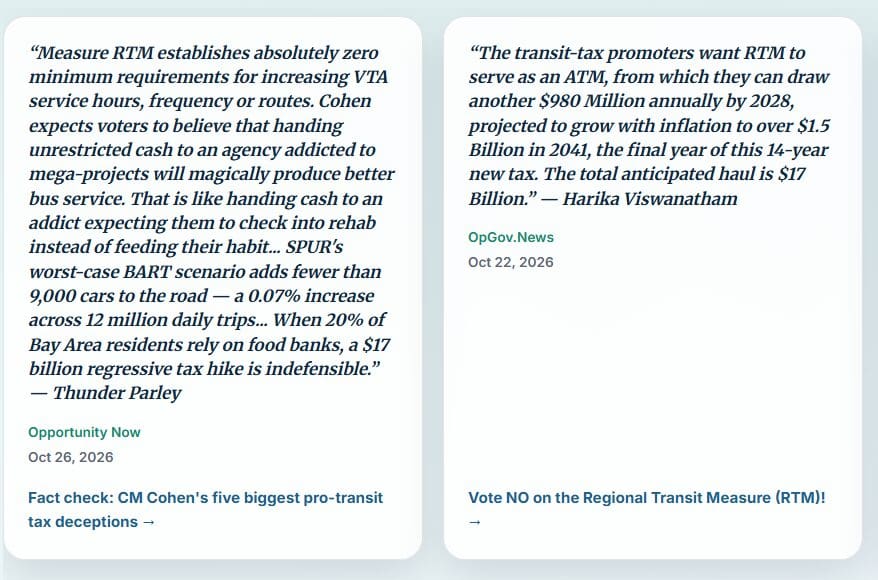
“Opposing the initiative is not a vote against public transit. It’s a demand for responsible financial management…. Vote No.”
* The Mercury News / East Bay Times Editorial Board
Updates & News
The cost-of-living hit comes first
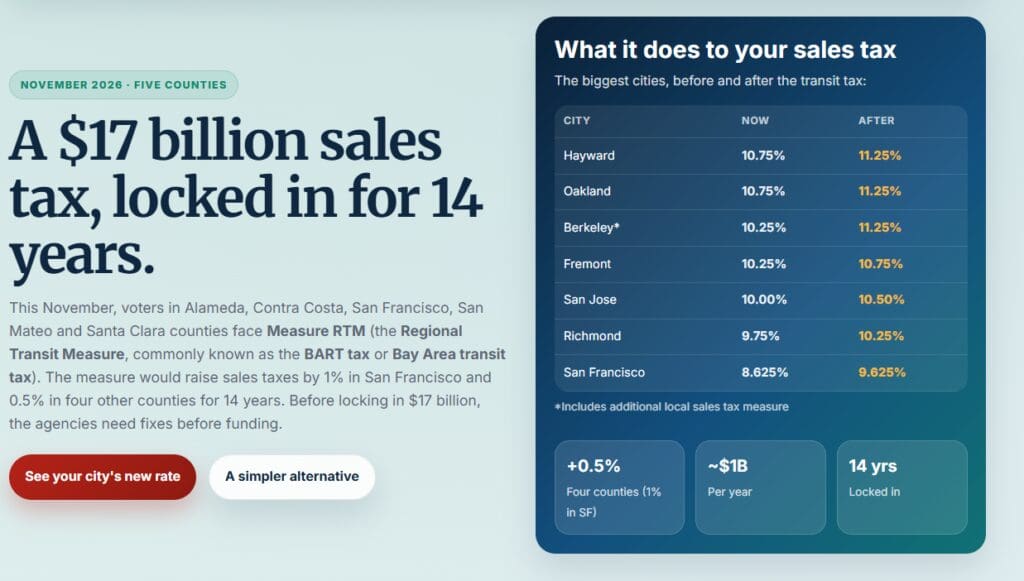
The Bay Area already carries some of the highest sales taxes in California. Combined with other local sales tax measures on the ballot, Measure RTM would push eight Alameda County cities past 11% and drive Pacifica’s rate to 11.375%. Sales tax is regressive and falls hardest on working families, renters and anyone living paycheck to paycheck. It taxes what you spend rather than what you earn and applies to major purchases like vehicles, bikes, clothes, meals and building supplies, driving rents up even further.

What the measure actually does
The tax was authorized by SB 63 (Wiener, 2025), which lets a new Metropolitan Transportation Commission body, the Public Transit Revenue Measure District, place a 14-year sales tax before voters in five counties. The four northern counties, Marin, Napa, Solano, and Sonoma, opted out.
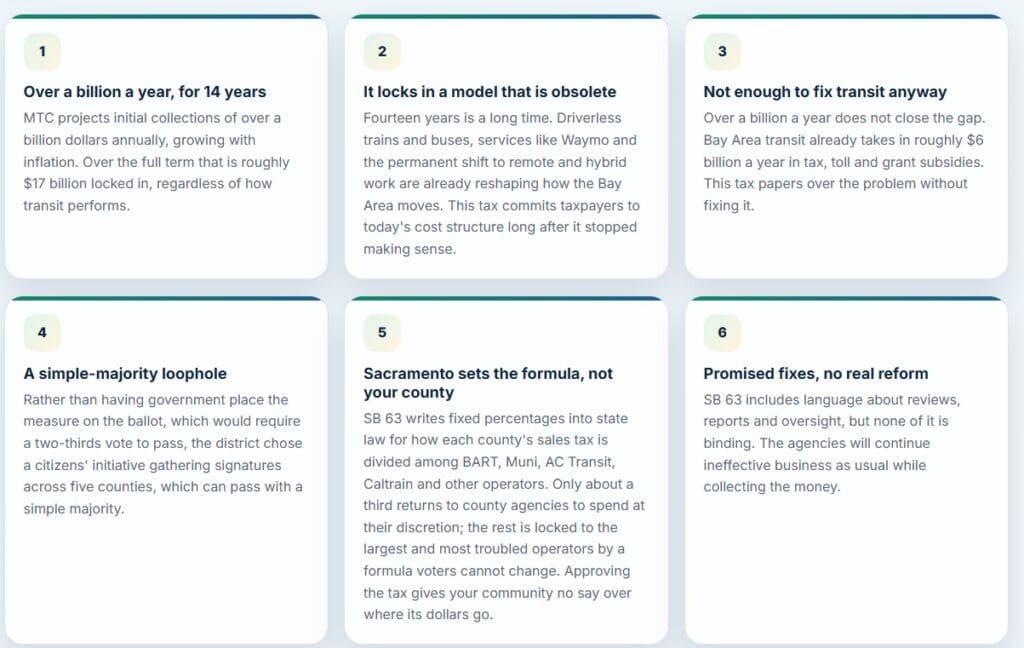
Transit already gets $6.2 billion a year from taxes & tolls
Before the region asks for another billion dollars a year, look at what it already collects. In fiscal year 2024-25, the Bay Area’s transit operators took in roughly $6 billion in tax, toll, and government grant subsidies across the five counties, on top of the fares, parking, and advertising revenue they also keep.

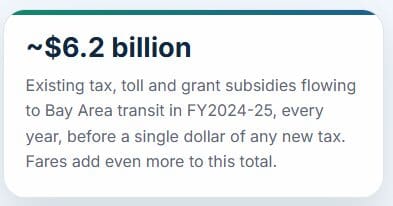
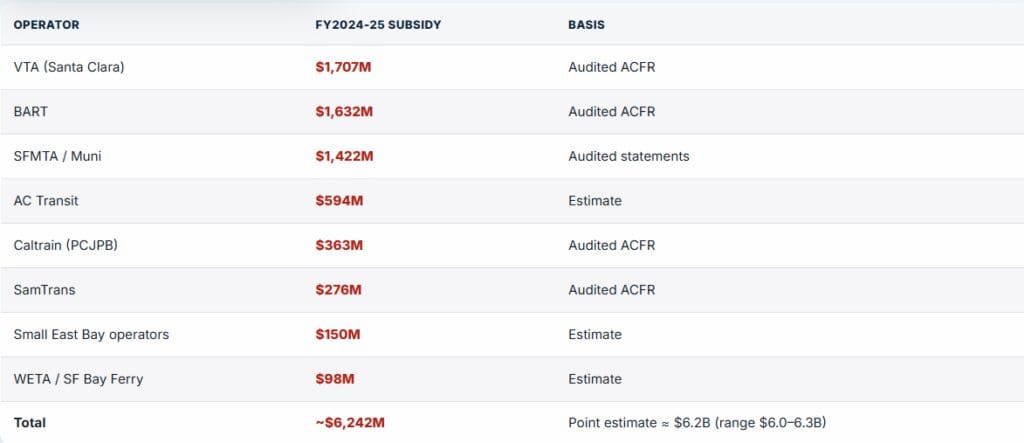
Tax, toll, and government grant subsidies to Bay Area transit operators in fiscal year 2024-25, in millions of dollars, covering Alameda, Contra Costa, San Francisco, San Mateo, and Santa Clara counties. The figures exclude fares, parking, advertising, investment income, and express-lane tolls. Audited amounts are drawn from each operator’s FY2024-25 Annual Comprehensive Financial Report or audited statements; rows marked “estimate” rely on budgets or the prior audited year because the FY2024-25 report is not yet published. Bridge-toll subsidies (Regional Measures 1, 2, and 3) are embedded in several operators’ local-funds and capital lines. Some county and regional funds pass through MTC, CCTA, the Alameda CTC, and the SFCTA before reaching operators.
The VTA and SFMTA totals are agency-wide and include some non-transit functions, such as local streets and parking; a portion of Santa Clara’s 2016 Measure B is dedicated to roads rather than transit. Caltrain’s capital figure includes about $60 million in member-agency contributions that also appear in the SamTrans, SFMTA, and VTA totals. Netting those overlaps and adding the operators left off this list, such as Golden Gate Transit’s San Francisco service, the Capitol Corridor, and ACE, leaves a point estimate near $6.2 billion.
What is Measure RTM (the Regional Transit Measure)?
Why is Measure RTM often called the BART Tax”?
Why vote NO on this Bay Area Transit tax?
Which Counties are included in the Bay Area transit measure?
Ho much money does Bay Area transit already receive ?
Take action
We are organizing the opposition across all five counties and we need help.