

On November 3, Santa Clara County voters approved Measure RTM with 56% support, joining voters elsewhere in the Bay Area in authorizing another sales tax for public transit. T
Voters were told the additional tax revenue was needed to prevent cuts to bus and rail service. But just nine days after the election, a Santa Clara Valley Transportation Authority (VTA) oversight committee meeting provided a reminder of why taxpayers should be skeptical of the agency’s financial management.
VTA’s BART Silicon Valley Phase II project, which would extend BART through downtown San Jose to Santa Clara, is facing mounting costs, uncertain federal funding, and a construction contract that leaves taxpayers exposed to potentially enormous cost overruns.
The project’s current budget is approximately $12.75 billion, and VTA officials now acknowledge that the revised estimate will be significantly higher, with one knowledgeable public commenter suggesting that the price tag will reach an eye watering $15 billion. Yet the agency continues moving forward with construction.
A construction contract without an effective price ceiling
One of the most troubling revelations concerns VTA’s amended agreement with Kiewit Shea Traylor (KST), the contractor responsible for the project’s five-mile tunnel and trackwork.
Instead of negotiating a conventional fixed-price contract, VTA agreed to a target-price arrangement that its independent engineering consultant, Gall Zeidler, says leaves the agency responsible for potentially unlimited allowable reimbursable costs.
Of the contract’s $110 million in fees subject to performance incentives, only $45 million is specifically tied to controlling costs. The remainder concerns schedule performance and other measures.
Gall Zeidler identified nine critical contract risks, including the absence of a binding ceiling on reimbursable costs. Although the contract contains cost-sharing provisions, the consultant concluded that VTA bears most of the financial exposure from major overruns.
VTA disputes the characterization of its liability as unlimited. It argues that reimbursements are restricted to documented, allowable costs and that the contractor cannot collect additional fixed fees when costs increase. Some VTA reports also refer to a $3.55 billion total contract cap, although the Auditor General has flagged inconsistencies between that figure and the absence of a Stage 2 cost ceiling.
But limiting reimbursement to allowable costs is not the same as limiting the total amount taxpayers may be required to pay. And a contractor’s inability to increase its profit does little to protect taxpayers from soaring construction expenses.
Even worse, major elements of the tunnel project, including trackwork, mechanical and electrical systems, and station connections, were designated as optional work without fixed prices. VTA could negotiate those components directly with KST rather than obtaining competitive bids, although the agency says it retains the option to seek competing offers.
This is hardly a recipe for controlling construction costs.
Federal funding keeps slipping
VTA has been counting on approximately $5.1 billion in federal funding through a Full Funding Grant Agreement (FFGA). But that agreement remains elusive.
VTA’s September progress report no longer provides a specific target date for executing the agreement. Instead, the milestone is listed as “TBD,” replacing the previously reported fourth-quarter 2027 target.
The project already has a reported $587 million funding shortfall. The Auditor General estimates that updating the 2024 cost baseline to 2026 dollars could add another $600 million to $850 million in costs, although those increases must be reconciled with any savings from the project’s redesign.
Federal officials will expect VTA to demonstrate that it has a credible financing plan before committing billions in additional funding. The agency cannot simply assume that Washington will cover whatever costs emerge.
Meanwhile, VTA’s financial reporting provides additional reasons for concern.
The Auditor General found that two internal reports presented substantially different figures for contingency spending: approximately $164 million in one and $406 million in another. The difference remains to be reconciled.
The Auditor General also reported that while approximately $2.9 billion in contract commitments had been recorded, approved but unrecorded commitments could push total obligations above $5 billion. That compares with an approved budget of roughly $3.3 billion covering the period through fiscal 2027, although not all the commitments would be spent during that period.
These discrepancies make it harder for oversight officials and taxpayers to understand how much VTA has committed and how much financial flexibility remains.
Dig first, figure out the cost later
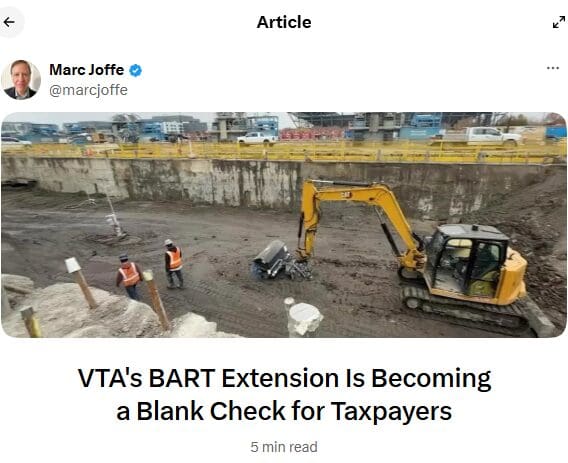
Despite these uncertainties, VTA continues preparing for tunneling. The agency has excavated an 83-foot launch structure for a $76 million tunnel boring machine.
Meanwhile, VTA acknowledges that design work on other portions of the project, including station finishes, track systems, and the Santa Clara station, has been slowed.
This raises an obvious question: Why proceed with an expensive tunnel before determining whether the agency can afford to complete the line?
VTA is now developing what it calls an “Adaptive Plan,” under which the extension could be built in phases, potentially opening with fewer stations than originally promised.
In other words, taxpayers could end up paying substantially more for substantially less.
A shortened BART extension might sacrifice some of the connectivity and ridership benefits used to justify the project. And once billions have been invested in the tunnel, political pressure to spend additional billions completing the line will become nearly irresistible.
Will Measure RTM become another source of bailout money?
VTA insists that it will not use Measure RTM revenue to fund the BART extension. But the measure’s legal language raises questions about how firmly that commitment is protected.
Under SB 63, 84.37% of the sales tax revenue generated in Santa Clara County goes to VTA for public transit expenses and certain road improvements. The law defines public transit expenses to include capital improvement projects that maintain or improve transit service.
That definition is broad enough to raise a legitimate question about whether RTM money could eventually be used for the BART extension. The relevant statutory language contains no express prohibition on doing so.
VTA officials have pledged not to allocate the new tax revenues to the extension. But what prevents a future board from changing that policy if the project’s funding gap grows by billions?
Even if RTM dollars never go directly into the BART project, the new revenue could potentially free up other VTA resources for construction. Tax dollars are not necessarily insulated from one another simply because they appear in different accounts.
Taxpayers deserve a clear explanation of what legally enforceable protections, if any, prevent the new sales tax from becoming another source of financing for the troubled extension.
Time for a reality check
Santa Clara County residents have already committed billions in sales tax revenue to VTA through earlier ballot measures. They are now paying another transit tax while the agency advances a megaproject whose ultimate cost and completion date remain uncertain.
VTA is expected to release an initial revised project baseline in December. If the new estimate is substantially higher, the agency should not simply adjust its financing assumptions and continue digging.
It should seriously reconsider the project’s scope, contracting arrangements, and alternatives.
An agency that cannot establish a credible construction budget should not be allowed to treat taxpayers as an unlimited source of funding. Unfortunately, however, a large majority of Santa Clara voters are giving VTA a blank check.
